
Wildfire Smoke’s Hidden Threats: When Particle Size and Chemistry Undermine Filtration
Fall 2025 Air Media
By Sissi Liu, CEO, Metalmark Innovations, PBC
Wildfire smoke particles fall into a filtration blind spot—small enough to evade mass-based sensors, yet chemically potent enough to degrade filter media. Understanding their unique size and composition is key to protecting indoor air.
WILDFIRES SMOKE: A GROWING GLOBAL AIR QUALITY CRISIS
Wildfires are becoming more frequent, more intense, and more widespread. Across North America—and increasingly around the globe—wildfire smoke is now one of the most significant drivers of air pollution. The Western U.S. and Canada have seen record-breaking wildfire seasons, with smoke impacting regions far beyond the burn zones.1
In summer 2025, Canada is again battling dozens of active wildfires, continuing a multi-year trend of long-range smoke events. In 2023, over 500 Canadian wildfires produced smoke that blanketed much of the U.S. Midwest and East Coast, triggering the worst air quality days on record for over 120 million Americans. That same smoke eventually reached Europe. Meanwhile, recent wildfires in Los Angeles have demonstrated the risks of wildland–urban interface fires, where not only vegetation but also buildings, vehicles, and infrastructure burn—introducing more toxic and chemically diverse pollutants into the atmosphere.
These events are not isolated anomalies. They signal a broader, more troubling trend. According to data from the NOAA/NESDIS Hazard Mapping System, smoke days across the Eastern and Central U.S. have tripled between 2022 and 2024. What was once a regional hazard is now a national crisis. As shown in Figure 1, NOAA data reveals a dramatic expansion in national smoke exposure: in 2008, smoke days were concentrated in the West, but by 2024, the eastern half of the U.S. regularly experiences over 140 smoke days per year—highlighting how wildfire smoke has become a nationwide threat. At the same time, as the wildland-urban interface expands, so too does the strain on building ventilation systems, public health infrastructure, and the ability of filters to manage smoke exposure.
Wildfire smoke contains a complex mixture of gases and particles.2 PM2.5 reported in μg/m3 is commonly used to assess exposure risk, but this mass-based metric doesn’t capture the number, size, or chemical activity of smoke particles. For filtration professionals, the question is no longer if wildfire smoke matters. Rather, what exactly are we filtering in this new era of widespread, persistent smoke exposure?
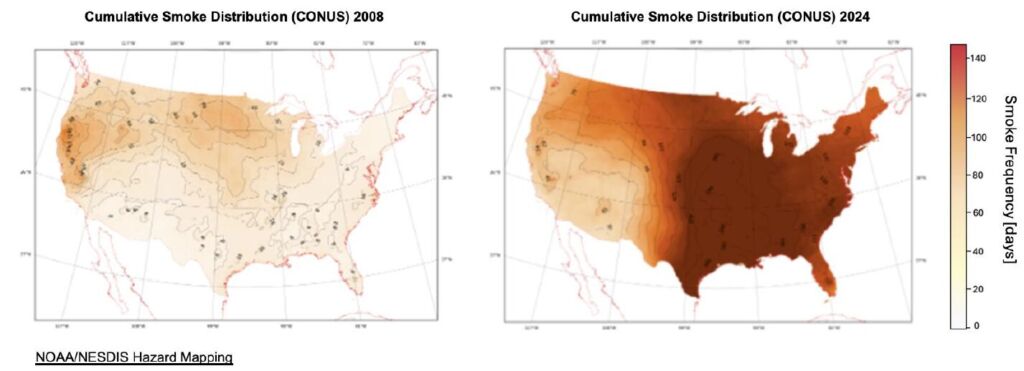
Figure 1. Change in cumulative wildfire smoke exposure across the continental U.S. from 2008 to 2024, based on NOAA/NESDIS Hazard Mapping System data (link). In 2008, wildfire smoke exposure was largely confined to the western states. By 2024, smoke frequency exceeded 140 days per year across much of the eastern U.S.—a dramatic national shift reflecting increased wildfire activity, long-range smoke transport, and expansion of fire-prone areas.
UNDERSTANDING WILDFIRE PM
Wildfire smoke is a complex mixture of gases and particles that poses a unique challenge to indoor air quality (IAQ) and filtration systems.2 While most public health guidance and building standards focus on PM2.5, this metric has inherent limitations when applied to wildfire smoke.
PM2.5 refers to particles with an aerodynamic diameter of 2.5 micrometers or smaller. It was originally developed as a health-based regulatory standard for ambient air pollution, primarily from sources like vehicle emissions and industrial combustion. PM2.5 levels are reported in mass concentration (micrograms per cubic meter, μg/m³), and form the basis for the U.S. EPA’s Air Quality Index (AQI) as well as most current guidance for wildfire smoke exposure.
However, PM2.5 :
- Does not reflect particle number or surface area, which are more relevant to particle toxicity;
- Was not developed with wildfire smoke in mind, and does not account for the unique size distribution and chemistry of biomass combustion;
- Can underestimate risk when the smoke is dominated by very small (<0.5 μm) and chemically reactive particles;
Most wildfire PM is submicron, typically in the range of 100–300 nanometers (nm), and is largely composed of organic aerosols, along with soot, salts, and trace metals. This particle size range is undetectable by optical PM2.5 sensors.3 Wildfires also emit a wide range of volatile organic compounds (VOCs) that can contribute to ozone formation and secondary organic aerosols, both indoors and outdoors. This chemical complexity can degrade filter media over time.3
Submicron particles, especially 0.3 microns and smaller–what we call super-fine particles–are particularly concerning. They can penetrate deep into the lungs, enter the bloodstream, and have been linked to cardiovascular disease, asthma, inflammation, and DNA damage.4 Because of their small size and high surface area, they can also carry toxic compounds and remain suspended in the air for long periods, increasing the chance of inhalation and indoor infiltration.
Numerous field and laboratory studies—including our own measurements of pine needle smoke as a proxy for wildfire smoke—show that wildfire smoke particles overwhelmingly fall below 0.3 μm, well under the PM2.5 cutoff and beyond the sensitivity range of many commercial building and even laboratory PM sensors and standard filtration tests (Figure 2).3,5
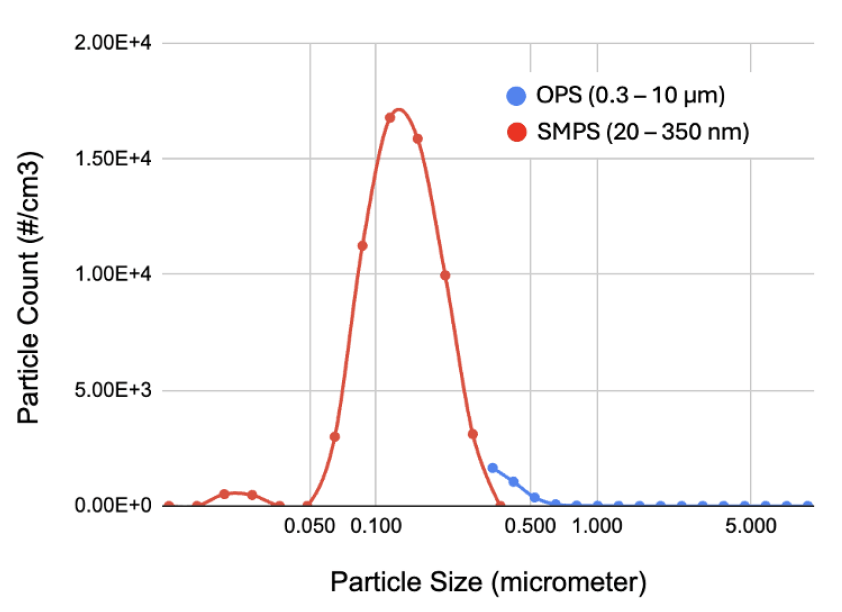
Figure 2. Particle size distribution of pine needle smoke measured in a lab chamber using TSI SMPS (20–350 nm) and OPS (0.3–10 μm). Most particles fall between 100–300 nm, peaking near 200 nm. This size range aligns with those of other studies and highlights a critical gap in PM2.5 mass-based monitoring and filter testing around 0.3 μm MPPS.
The predominance of sub-0.3 μm particles has implications that go far beyond what mass concentration alone can reveal. At the same mass concentration, submicron particles vastly outnumber and outweigh larger ones in terms of number and surface area. For example, at 10 μg/m3 each, 200 nm particles yield over 1.6 billion particles per cubic meter compared to ~800,000 particles for 2.5 μm particles—2000 times more! This is a critical difference that mass-based metrics simply don’t capture. See Figure 3.
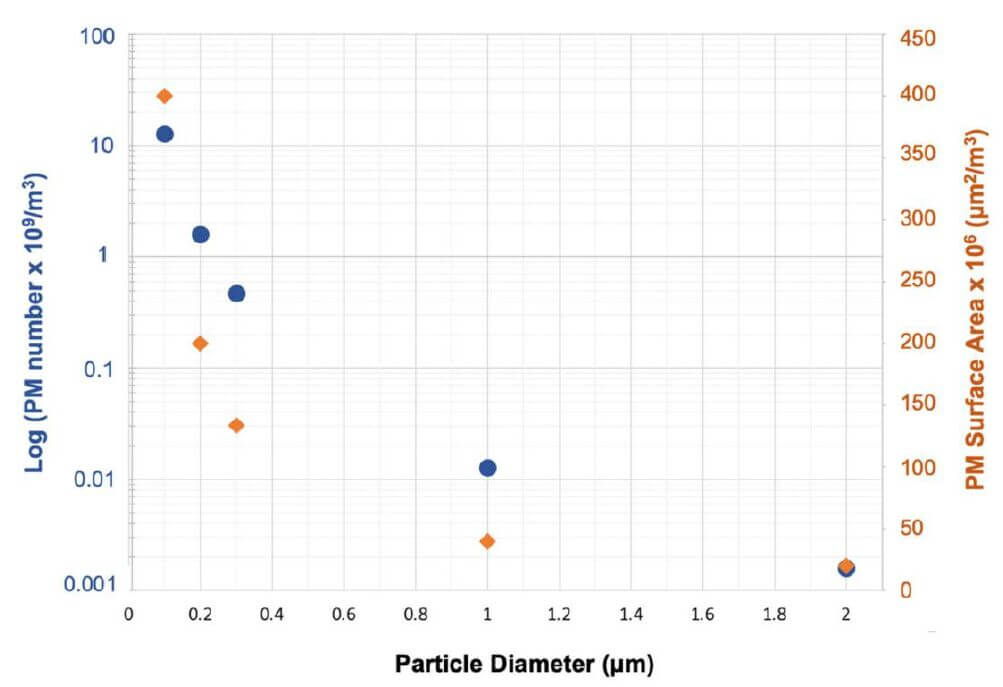
Figure 3. Particle number and surface area as a function of particle diameter at a fixed wildfire smoke concentration of 10 μg/m³. Assumes spherical particles with a density of 1.5 g/cm³. Blue circles (left axis) show the logarithm of number concentration; orange diamonds (right axis) show total surface area. As size decreases, particle number skyrockets and surface area stays high—revealing the limitations of relying solely on PM2.5 mass or 0.3 μm-based filter ratings.
SMOKE PARTICLE COMPLEXITY EXPOSES WEAKNESSES IN FILTERS AND STANDARDS
Conventional fibrous filters used in HVAC systems play a critical role in maintaining indoor air quality by removing particulate matter (PM). However, their performance against wildfire smoke particles remains significantly understudied.6
Some research suggests that HVAC systems—particularly those using low to medium-efficiency filters—can actually increase indoor particle concentrations during smoke events. One study found indoor PM levels to be 83% higher in ventilated buildings compared to sealed ones, raising questions about the effectiveness of typical HVAC-driven filtration during wildfire exposure.7
Despite their limitations, HVAC filters remain the primary defense for both residential and commercial buildings. Their effectiveness depends not only on media properties, but also on filter and HVAC system design, runtime, and filter aging—all of which can influence actual protection during a prolonged smoke event.
One fundamental problem is how filter efficiency is measured. Most test standards—including ASHRAE 52.2 and EN779/ISO 16890—focus on particles ≥0.3 μm, while wildfire smoke is dominated by sub-0.3 μm particles. Furthermore, they (e.g., ASHRAE 52.2, including Appendix J, EN1822) rely on inorganic test aerosols like potassium chloride (KCl), which do not accurately represent the behavior of organic-rich wildfire smoke. As a result, current filtration metrics may overstate real-world performance for wildfire smoke scenarios.
Recognizing a major gap in data and testing around wildfire smoke filtration, we conducted controlled studies on filter media from over 17 different media types across MERV 11–15. Furthermore, in collaboration with LMS Technologies, we compared standard KCl test results with pine needle smoke (a close proxy of wildfire smoke) performance of a MERV 11 electrostatically charged (electret or charge) filter media (Figure 4A).5 Despite meeting MERV 11 performance with KCl, the same electret media showed dramatically reduced efficiency against pine needle smoke, particularly in the 100–300 nm range. Notably, this drop occurred without a corresponding increase in pressure drop. Using scanning electron microscopy (SEM), we observed fine smoke particles depositing as small droplets or “beads” on filter fibers (Figure 4B) a pattern markedly different from the solid accumulation seen with inorganic salts like KCl.
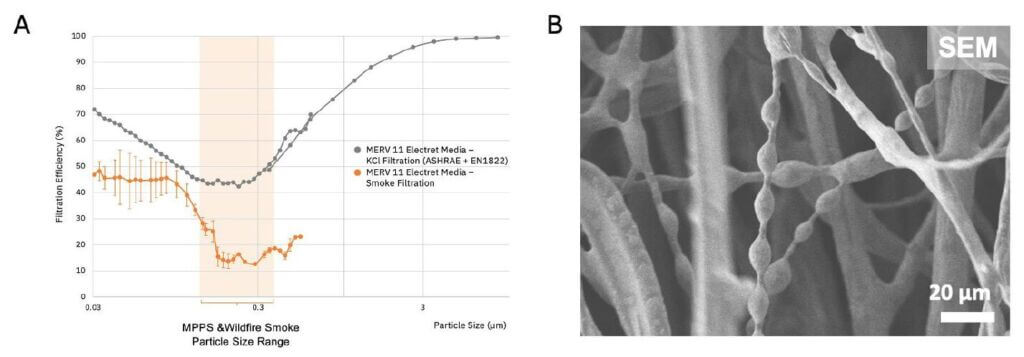
Figure 4. (A) Filtration efficiency of MERV 11 media measured with KCl (gray line) vs. pine needle smoke (orange line) at LMS Technologies. Smoke removal efficiency is significantly lower than predicted by MERV performance. (B) SEM image showing droplet-like deposition on electret fibers after smoke exposure.
This behavior appears to interfere with electrostatic capture mechanisms. To better understand the effect, we conducted extended testing (Figure 5), to monitor how the filtration efficiency of pine needle smoke changes over time during continuous smoke exposure. The results showed:
- Electrostatically charged polymer media lost up to 75–80% of their efficiency after 80 minutes of smoke loading, regardless of MERV grade.
- Higher MERV grades (e.g., 15) degraded faster than lower ones—a surprising and counterintuitive result.
- Mechanical polymer and fiberglass media exhibited more stable efficiency, but at the cost of far higher pressure drop.
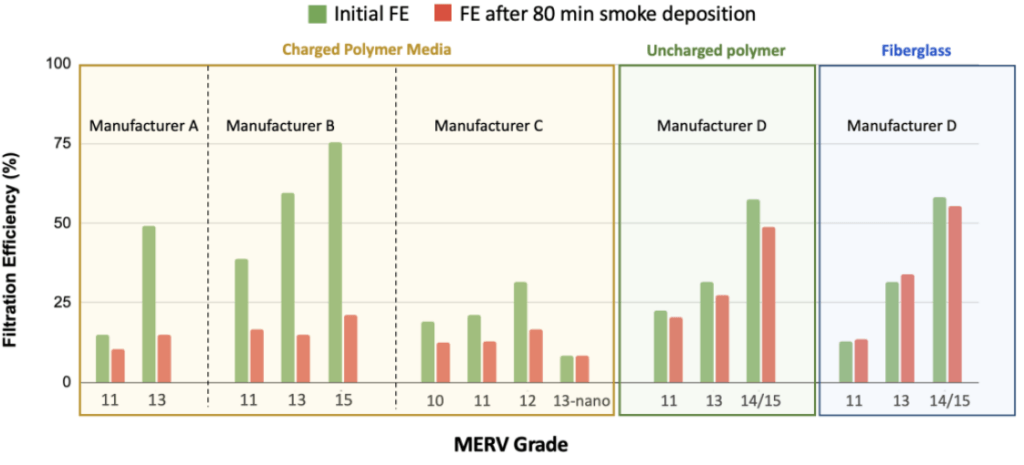
Figure 5. Initial (green) and post-aging (red) smoke filtration efficiency for various MERV-rated media. Electret media lose filtration performance rapidly with minimal pressure drop; mechanical media remain stable but have higher resistance.
Importantly, pressure drop remained largely unchanged across all filter types—even when efficiency plummeted—suggesting that relying on PD as a filter change indicator during wildfire events could be misleading.
Key Takeaways:
- Electret filter media show strong initial performance in standard tests but degrade rapidly in filtration of smoke.
- MERV rating may not be representative of filtration efficiency for smoke, especially for charged media.
- Mechanical media (e.g., fiberglass) offers more stable performance but introduces airflow penalties.
- Pine needle smoke testing reveals the need for revising test standards and performance expectations against wildifre smoke.
Looking ahead
As wildfire smoke becomes a more common air quality threat, it's clear that many HVAC filters—especially widely used electret media rated MERV 11–14—may not provide enough protection. Current testing standards do not reflect real smoke conditions, and most public guidance is disconnected from how smoke particles interact with filters in real environments. To move forward, we need better testing, improved standards, and smarter filter choices based on real-world considerations.
Key Takeaways:
- MERV-rated filters may underperform against wildfire smoke.
- Filtration standards should evolve to encompass considerations of smoke filtration
- Particle number and size matter more than just PM2.5 mass when it comes to wildfire smoke.
- Pressure drop is not always a sign of filter degradation in smoke removal applications.
- Better understanding of filter media behavior will drive smarter IAQ solutions.
REFERENCES
- Jaffe, D.A.; O’Neill, S.M.; Larkin, N.K.; Holder, A.L.; Peterson, D.L.; Halofsky, J.E.; Rappold, A.G.Wildfire and prescribed burning impacts on air quality in the United States. J. Air Waste Manag. Assoc. 2020, 70, 583–615.
- Aurell, J.; Gullett, B.K. Emission Factors from Aerial and Ground Measurements of Field and Laboratory Forest Burns in the Southeastern U.S.: PM2.5, Black and Brown Carbon, VOC, and PCDD/PCDF. Environ. Sci. Technol. 2013, 47, 8443–8452.
- (a) Joo T, Rogers MJ, Soong C, Hass-Mitchell T, Heo S, Bell ML, Ng NL, Gentner DR. Aged and Obscured Wildfire Smoke Associated with Downwind Health Risks. Environ. Sci. Technol. Lett 2024, 11, 1340-1347. (b) Laing, J. R., Jaffe, D. A., and Hee, J. R.: Physical and optical properties of aged biomass burning aerosol from wildfires in Siberia and the Western USA at the Mt. Bachelor Observatory, Atmos. Chem. Phys., 16, 15185–15197.
- (a) Aguilera, R., Corringham, T., Gershunov, A. et al. Wildfire smoke impacts respiratory health more than fine particles from other sources: observational evidence from Southern California. Nat Commun 12, 1493 (2021). (b) Reid Colleen, E.; Brauer, M.; Johnston Fay, H.; Jerrett, M.; Balmes John, R.; Elliott Catherine, T. Critical Review of Health Impacts of Wildfire Smoke Exposure. Environ. Health Perspect. 2016, 124, 1334–1343.
- (a) Shirman, T.; Shirman, E.; Liu, S. Evaluation of Filtration Efficiency of Various Filter Media in Addressing Wildfire Smoke in Indoor Environments: Importance of Particle Size and Composition. Atmosphere 2023, 14, 1729. (b) Shirman, T.; Zamani, H.; Liu. S. Wildfire smoke - a stringent test for HVAC air filters. Submitted
- Holder, A.L.; Halliday, H.S.; Virtaranta, L. Impact of do-it-yourself air cleaner design on the reduction of simulated wildfire smoke in a controlled chamber environment. Indoor Air 2022, 32, e13163.
- Dev, S.; Barnes, D.; Kadir, A.; Betha, R.; Aggarwal, S. Outdoor and indoor concentrations of size-resolved particulate matter during a wildfire episode in interior Alaska and the impact of ventilation. Air Qual. Atmos. Health 2022, 15, 149–158