
Achieving Truly Effective Air Filtration in Residential Applications
Spring/Summer 2025 Air Media
Dan Dearden CAFS, NATE Senior Efficiency Analyst, RSES CMS, NCI HVAC Efficiency Analysis Certified, IGSHPA Certified, Air Balance Certified.
As a young HVAC technician in the late 1970s, I often faced a curious contradiction. Customers who had purchased our "best" air cleaners were dissatisfied, complaining about dust still settling on furniture or visible particles floating in sunlit rooms. Despite their investment, the air in their homes didn’t feel “clean” enough. I checked and rechecked everything: the voltages on electronic air cleaners, the media filters, and even advised running furnace fans continuously. Still, the complaints persisted until they eventually resigned themselves to subpar results.
Fast-forward three decades, and my perspective shifted completely. Armed with a laser particle counter, I began testing the actual performance of air filtration products, including those we installed and those sold by competitors. The results were eye-opening. Most filters fell far short of their advertised efficiency. One exception stood out: the Perfect 16 by IQAir, which consistently delivered as promised. A close second was Lennox’s Healthy Climate Carbon Clean 16. The rest ranged from mediocre to downright ineffective, with some removing as little as 5% of fine particulates. Non-particulate filter products, like bipolar ionizers and photocatalytic oxidizers, were particularly disappointing, failing to meaningfully reduce airborne particles in homes.
Although we loved the Perfect 16, it had a major limitation: its size. It simply didn’t fit in most residential HVAC systems. Out of frustration—and inspired by customers’ needs—I decided to invent my own solution. Enter the NovusAer air filtration unit, which I spent five years developing and field testing. Unlike most filters, the NovusAer could fit in nearly any home and captured 100% of PM 2.5 particles, obtaining near HEPA efficiency while achieving a pressure drop that of standard residential media filters.
But even the best filter isn’t enough when there’s a bigger issue at play: air infiltration. This became clear when we installed a NovusAer unit in the home of a boy with severe respiratory issues. Although the filter worked as designed, the air quality in the home was still suboptimal. Why? Infiltration air—dirty, unfiltered outdoor air seeping into the home—was diluting the effectiveness of the system.
The Infiltration Problem
According to a 2002 Lawrence Berkeley National Laboratory study, the average pre-1994 home experiences 1.18 natural air changes per hour (ACH nat). For a 1,500-square-foot home with a basement, that translates to roughly 295 cubic feet per minute (CFM) of unfiltered air entering the home. Even with a high-performance air filter delivering 1,200 CFM of clean air, the infiltration reduces the system’s effective air filter efficiency by 25%. A MERV 16 filter might deliver the equivalent of MERV 11 performance in such conditions, while a MERV 13 filter might only reach MERV 10.
A Game-Changing Solution: Depressurization Ducts
To address this, we began incorporating a simple but effective modification: a depressurization duct. By installing a 6-inch duct with a manual adjustable damper from the outside of the home to the HVAC system’s return air plenum (upstream of the filter), we could filter incoming infiltration air. During setup, we adjusted the damper to equalize the pressure difference between the inside and outside of the home to 0 pascals, ensuring no unfiltered air was seeping in.
When we revisited the home with the boy who had respiratory issues, the improvement was dramatic. The family reported significantly better air quality, and their son’s symptoms eased noticeably. From then on, we offered depressurization ducts with every NovusAer installation, later standardizing on 8-inch ducts for even better results.
Reducing Visible Dust
Beyond health benefits, depressurization ducts help with another common complaint: visible dust. Much of the dust settling on furniture comes from unfiltered infiltration air. By filtering all incoming air, these ducts reduce the dust load dramatically. While it’s not a flawless solution, it’s one of the most effective approaches we’ve found.
Real-World Results
Even in challenging environments, like my own home in Salt Lake City, depressurization ducts have proven their worth. Our high mountain valley often suffers from severe air pollution due to temperature inversions, yet my indoor air quality remains pristine. With a furnace running at just 25% continuous fan speed, my air monitors consistently read 0 PM 2.5 particles, regardless of outdoor conditions. Customers with similar setups have reported equally impressive results.
The Takeaway
Achieving clean indoor air isn’t just about choosing the best filter. It’s about addressing the broader system, including the impact of air infiltration. By combining high-efficiency filtration with a well-designed depressurization duct, homeowners can enjoy truly clean air—free from harmful particulates and visible dust—no matter the environment. If you’re serious about air quality, it’s worth investing in a comprehensive solution that tackles the problem from every angle.
Managing indoor air quality (IAQ) to optimize occupant health is no longer just an engineering or facilities issue—it has become a frontline clinical and operational imperative. The IAQ within a healthcare facility directly influences patient recovery, staff productivity, and the hospital’s overall performance.
Historically, IAQ management has focused primarily on occupant comfort and on controlling airborne pathogens through ventilation, filtration, and pressurization control. While human comfort and the reduction of infectious bioaerosols are essential, emerging research paints a broader and more urgent picture.
We now know that even low levels of airborne particles and chemical pollutants—well below regulatory thresholds—can significantly disrupt human physiology. Airborne contaminants are not inert; they act as biological stressors that can:
- Trigger oxidative stress and chronic low-grade inflammation, which hinders tissue repair and immune response.
- Weaken immunity, making patients more susceptible to infections and delaying recovery.
- Disrupt endocrine balance, affecting metabolic regulation, wound healing, and mental health.
- Alter the human microbiome shifting microbial balance toward dysbiosis and increasing vulnerability to pathogens.
In a healthcare setting, these effects compound existing patient vulnerabilities and lead to slower recovery, greater susceptibility to complications, and higher readmission rates. For the staff, potentially stressed by demanding workloads and exposure to infectious material, poor IAQ is associated with fatigue, reduced cognitive function, more sick leave, and burnout. Even hospital operations are impacted, as poor IAQ is associated with increased treatment costs, reduced staff productivity, and lower patient satisfaction scores.

DRIVER OF HEALING AND PRODUCTIVITY
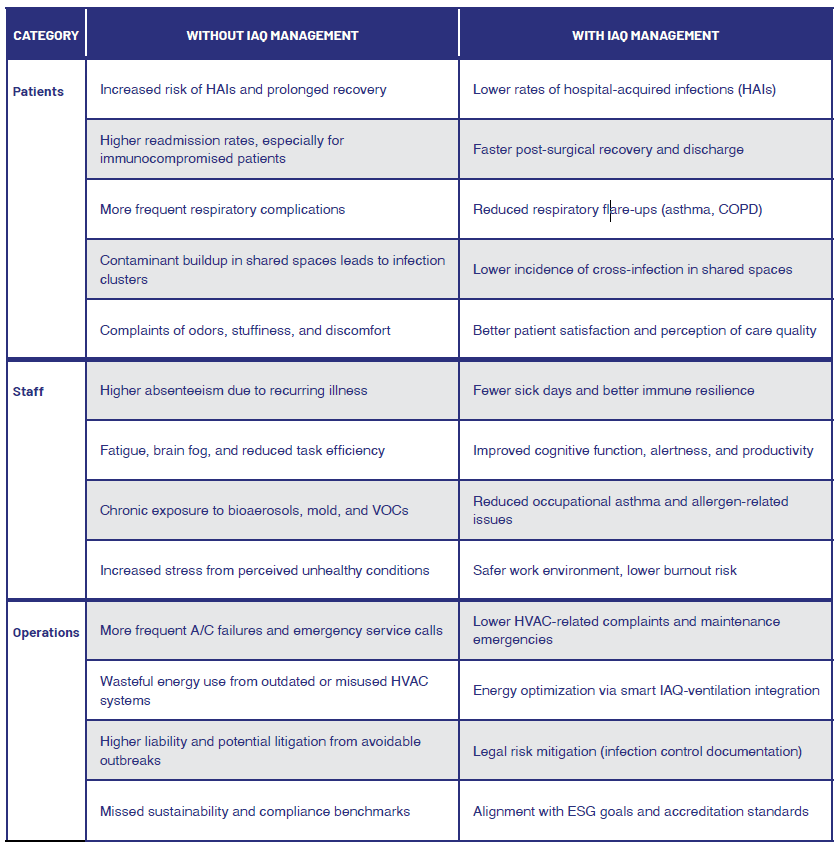
When IAQ management is woven into clinical care, the benefits extend far beyond infection prevention—delivering measurable gains in recovery speed, staff performance, and long-term facility cost-efficiency.
The takeaway is clear: IAQ management is not just important for managing comfort—it is a determinant of clinical outcomes. Where do we go from here?
CONTINUOUS MONITORING AND SMART INTEGRATION
Traditional IAQ management in healthcare relies on periodic checks and reactive maintenance—approaches that can leave dangerous gaps in occupant protection. In contrast, continuous
monitoring transforms air quality from a static facility parameter into a dynamic, real-time clinical and operational tool.
When combined with periodic building microbial assessments and patient outcome tracking, continuous IAQ monitoring enables a powerful feedback loop:
- Sensors allow for real-time alerts and rapid remediation by detecting deviations in particulate matter, volatile organic compounds (VOCs), ozone, carbon dioxide, humidity, and
microbial markers. These alerts allow environmental services and clinical teams to act before patient health is compromised—shifting from “damage control” to prevention mode. - Live IAQ data drives adjustments to ventilation, filtration, and humidity control to optimize airflow patterns, filtration efficiency, and moisture levels. For example, maintaining optimal
relative humidity (typically 40–60%) can suppress pathogen viability, support mucosal immunity, and reduce static electricity that may attract particles. - Monitoring facilitates predictive maintenance to prevent downtime and failures by identifying early signs of HVAC degradation, filter clogging, or microbial growth in ducts. When
maintenance can be scheduled before breakdowns occur, costly emergency repairs and unplanned service interruptions that can jeopardize patient safety are avoided. - IAQ data can integrate clinical protocols with the environment of care with infection control dashboards, electronic health records, and discharge planning for at-risk patients. This
visibility allows facilities to tailor room assignments, isolation protocols, or discharge recommendations based on actual environmental risk levels.
WHY IT MATTERS:
- In patient care areas—especially ICUs, oncology wards, and surgical suites—air quality is as critical as medication accuracy or sterile technique.
- In staff work zones, healthy air supports sustained concentration, reduces fatigue, and minimizes sick leave.
- At the facility management level, continuous monitoring aligns patient safety, staff wellness, and cost efficiency under a single, measurable strategy.
When smart IAQ integration becomes standard practice, healthcare facilities can shift from reactive environmental control to proactive health optimization—reducing risk, improving
recovery, and demonstrating measurable ROI.
WE NEED IAQ MANAGEMENT IN CLINICAL PROTOCOLS
Infection control has traditionally focused on surface disinfection, hand hygiene, PPE, and isolation procedures—all essential, but incomplete without addressing the air patients and staff breathe. IAQ management is needed for two critical areas of care:
Clinical Care Protocols: Integrating IAQ metrics into existing patient safety checklists, surgical site infection prevention protocols, and high-risk ward operations. Continuous air
monitoring informs ventilation adjustments, negative/positive pressure room controls, and filter change schedules. These interventions reduce airborne transmission risk, allow faster
recovery in vulnerable populations, and reduce hospital associated complications. Without IAQ Integration, air quality remains an unmeasured, reactive variable. Poor ventilation,
unnoticed microbial growth, and uncontrolled humidity persist until patient symptoms or equipment failures appear. This results in higher infection risk, longer hospital stays, and
greater strain on clinical staff.
Discharge Recommendations for At-Risk Patients: With IAQ Integration, patients with compromised immunity (postsurgery, oncology, transplant, COPD) can receive tailored home
environment advice—such as portable HEPA filtration, humidity targets, and avoidance of high-VOC exposures during recovery. Ideally, home IAQ monitoring can be linked to post-discharge follow-up, resulting in lower readmission rates, fewer postdischarge infections, and improved long-term outcomes. Conversely, without IAQ management, discharge planning
ignores environmental recovery conditions. Patients return to homes with uncontrolled airborne allergens, pathogens, and pollutants that undermine healing, leading to a higher likelihood of relapse, increased emergency visits, and preventable readmissions.
ECONOMIC CASE FOR IAQ MANAGEMENT
The costs and benefits of environmental monitoring and smart mechanical integration are shown in the following table.
Table 1: Costs vs. Value of IAQ monitoring and integration, yielding a net benefit when accounting for reduced infection rates, shorter stays, and lower staff turnover.
CONCLUSIONS
Investing in IAQ management is not just an environmental upgrade—it’s a clinical, operational, and financial strategy that supports the mission of healing and high-quality care. If IAQ is a known determinant of infection risk, immune function, and recovery speed, can a modern healthcare facility justify not embedding it into clinical protocols and patient discharge plans?
REFERENCES
- Allen, J.G., et al. (2016). Associations of cognitive function scores with carbon dioxide, ventilation, and volatile organic compound exposures in office workers: A controlled exposure study of green and conventional office environments. Environmental Health Perspectives, 124(6), 805–812. https://doi.org/10.1289/ehp.1510037.
- Kowalski, W.J., & Bahnfleth, W.P. (2002). Immune building systems technology. HPAC Engineering, 74(1), 20–29.
- Beggs, C.B., et al. (2015). The transmission of airborne infection in hospitals: Theoretical and experimental studies on ventilation effectiveness and infection risk. Indoor and Built Environment, 24(7), 1026–1036. https://doi.org/10.1177/1420326X15572420.
- Seppänen, O., Fisk, W.J., & Mendell, M.J. (1999). Association of ventilation rates and CO2 concentrations with health and other responses in commercial and institutional buildings. Indoor Air, 9(4), 226–252. https://doi.org/10.1111/j.1600-0668.1999.00003.
- World Health Organization (WHO). (2021). Roadmap to improve and ensure good indoor ventilation in the context of COVID-19. WHO Guidelines.
- US Centers for Disease Control and Prevention (CDC). (2023). Guidelines for environmental infection control in health-care facilities. https://www.cdc.gov/infection-control/hcp/environmental-control/index.html.
- National Health Service (NHS) England. (2022). Healthcare-associated infections: Annual epidemiological report. NHS Digital.
- Fisk, W.J., et al. (2011). Meta-analyses of the associations of respiratory health effects with dampness and mold in homes. Indoor Air, 21(3), 184–192. https://doi.org/10.1111/j.1600-0668.2010.00727.